
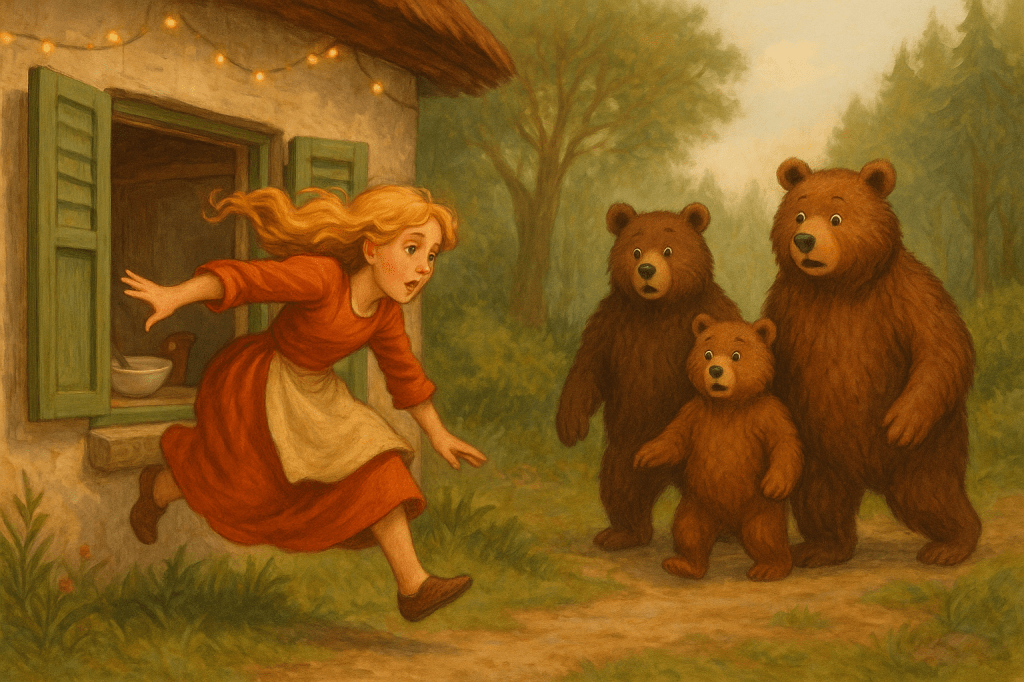
We’ve all grown up with Goldilocks and the Three Bears as a quaint bedtime story, a seemingly innocent girl with golden curls, guided by curiosity rather than conscience, who wanders into a home that isn’t hers, tasting, testing, and taking until she’s caught, then fleeing without consequence. Depending on the version, she either escapes into the woods, learns a gentle lesson, or, in some older tellings, faces harsher ends. But, the most pervasive version, the one that endures, is the one where she runs away unpunished, her innocence intact.
We are told she was just a hungry, curious child seeking warmth and shelter. Yet, that defense begins to unravel when we consider how quickly our empathy disappears in real life when those seeking shelter do not look like Goldilocks. When the lost and hungry are darker, poorer, or less “storybook,” society rarely calls their trespass curiosity. In fact, it calls it criminal.
So, consider this: in that familiar narrative, whose perspective is centered? Whose home is violated? Whose comfort, voice, and humanity are quietly dismissed?
What if we tell it from the bears’ vantage point — the rightful occupants — and reveal how the original fable trains us to accept intrusion, to normalize privilege, and to believe that the intruder holds a monopoly on the right to judge?
1. The Bears’ Home, Their World
Papa Bear, Mama Bear, and Baby Bear return from their walk expecting sanctuary. Yet, they find their home disturbed: someone’s broken into their space, consumed their food, shifted their furniture. They did not invite a stranger. Their home is theirs by birthright: the structure, the household, its rhythms.
Nonetheless, we rarely pause to imagine their shock. Instead, the original tale draws our attention and sympathy to Goldilocks, specifically her curiosity, her discomfort, her “just right” judgments. The bears become invisible, voiceless props, defined by their not being accommodating enough to the tastes of an intruder.
In that framing, we internalize a bias: the home invader as protagonist, the homeowners the ones at fault for making her trespass uncomfortable. This inversion mirrors colonial narratives (i.e., the colonizer as righteous explorer, the native or original inhabitant as irrelevant background noise).
2. Goldilocks as Intruder, Not Innocent Child
Think about it: Goldilocks saw a house, assumed it was empty, entered without permission, consumed the porridge, broke the chair, slept in the bed, then fled. In most legal or moral systems, that’s trespass, theft, and vandalism.
Yet, in the traditional retelling, she is painted as charming and curious, not predatory. Language softens her violation. She becomes a “little girl” instead of an interloper. The story trains us to accept certain behaviors from certain types of people and to see their entitlement as being justified.
By centering her curiosity, we’re conditioned to sympathize with her intrusion and disregard those who were harmed by it. The bears’ home becomes a stage for her adventure. Their feelings, their loss, their boundaries all made irrelevant.
3. The Conditioning: White Always Right
From earliest childhood, we are fed stories where white protagonists enter “mysterious lands,” claim authority, and change someone else’s home or life, always framed as discovery and improvement rather than disruption.
In “Goldilocks,” the subtext is clear:
- Any house in the woods is free to be entered by those who dare to enter.
- Outsiders have the right to judge, consume, disrupt, and leave when they’re displeased.
- The original occupants are secondary with their justified violation framed as overreaction.
This is not accidental conditioning. It trains us to empathize upward toward privilege, and away from those whose lives are disrupted by it.
4. Colonial Parallels in the Tale
When Goldilocks enters, she assumes authority. She tastes, she evaluates, she breaks. Then she leaves. The bears’ home remains disordered. The damage is lasting.
In colonial histories, colonizers entered lands, imposed standards, extracted value, and departed — leaving structural damage behind. Baby Bear’s broken chair isn’t trivial; it’s the destruction of something crafted, personal, and irreplaceable. Their consumed porridge is resource extraction. Their disturbed beds mark the violation of what was made to hold safety, cleanliness, and rest.
And like the colonial figure, Goldilocks flees without consequence, while the bears are left to rebuild.
Conclusion: Whose Story Are We Still Telling?
Seen through the bears’ eyes, Goldilocks and the Three Bears stops being a bedtime story and becomes a parable about entitlement. It shifts to being about how easily we’re taught to empathize with the intruder instead of the displaced. Even the choice to make the bears bears—not people—conditions us to dismiss their feelings as secondary, their pain as less human. Their portrayal as brown or black animals isn’t incidental; it’s a visual cue that subtly teaches the audience who deserves sympathy and who does not.
The story’s framing normalizes intrusion, excuses harm, and erases voice, the very mechanisms through which colonialism justifies itself.
Today, on Indigenous Peoples’ Day, that lesson still echoes. The stories we inherit shape the systems we sustain. Retelling them with awareness is an act of reclamation: a way of saying that every home, every land, and every voice deserves acknowledgment.
Decolonizing begins not only in law or protest, but in perception…in asking, Whose story have I been taught to believe? When we see the bears not as background, not as caricatures, but as rightful keepers of their home, we begin to unlearn the quiet conditioning of privilege and move closer to justice, one story at a time.
 Lence in Layers
One response to “When the Bear Family Speaks: The Story That Taught Us Not to Ask Why”
[…] explore this same idea in another piece, where I revisit ‘Goldilocks and the Three Bears’—this time through the lens of the […]
LikeLike