

Adulthood is supposed to mark the point where independence and responsibility become the norm, yet not everyone makes that leap. Some men cling to adolescence well into their adult years, relying on their partners to carry the emotional, mental, and practical weight of daily life.
Maybe you’ve seen it firsthand:
- He forgets to pay the electric bill (again) because “you’re better with details.”
- Dinner means you shopping, cooking, cleaning while he relaxes with a game controller.
- Arguments turn into him deflecting until YOU decide to smooth things over or let it go.
What can look like harmless immaturity at first, often evolves into something heavier:
a relationship where the woman becomes less of a partner and more of a caretaker.
The “Mom 2.0” Dynamic
Think about what happens when a couple moves in together. Instead of splitting chores, she ends up doing the grocery runs, laundry, scheduling maintenance appointments, and planning meals. At first, he jokes: “You’re just better at this stuff.” But, months later, it isn’t a joke, it becomes locked in.
That’s how the Mom 2.0 role begins. The relationship tilts from partnership into caretaking:
- Household tasks become hers by default.
- Reminders replace responsibility (“Did you call the landlord yet?”).
- Accountability vanishes, and blame shifts when things fall apart.
The emotional weight can be just as heavy. She becomes the manager of his moods, the one smoothing conflicts at family gatherings, and the official keeper of both their lives.
How Mothers Can Accidentally Enable Dependency
This doesn’t appear out of nowhere. A boy who never had to do chores, was excused from responsibility, or watched his mother step in to “save” him at every turn often grows into a man who expects the same from his partner.
- Scenario 1: Mom rushes to bring his forgotten homework to school. The pattern? Someone else will always clean up after his mistakes.
- Scenario 2: His sister sets the table, but he never has to. The lesson? Domestic work belongs to women.
- Scenario 3: Mom confides in him like a partner, blurring roles. Later, he expects his girlfriend to manage his emotions in the same way.
This doesn’t mean mothers are villains. It demonstrates how nurture, not nature entirely, teaches boys to lean on others instead of developing independence.
His Partner is Not to Blame for His Inadequacies
When these patterns carry into adulthood, the blame too often shifts in damaging ways:
- “If she had been more patient, maybe he would’ve stepped up.”
- “If she cooked more, encouraged him harder, forgave quicker…”
- “He meant well and wasn’t physically abusive…that’s a win, girl.“
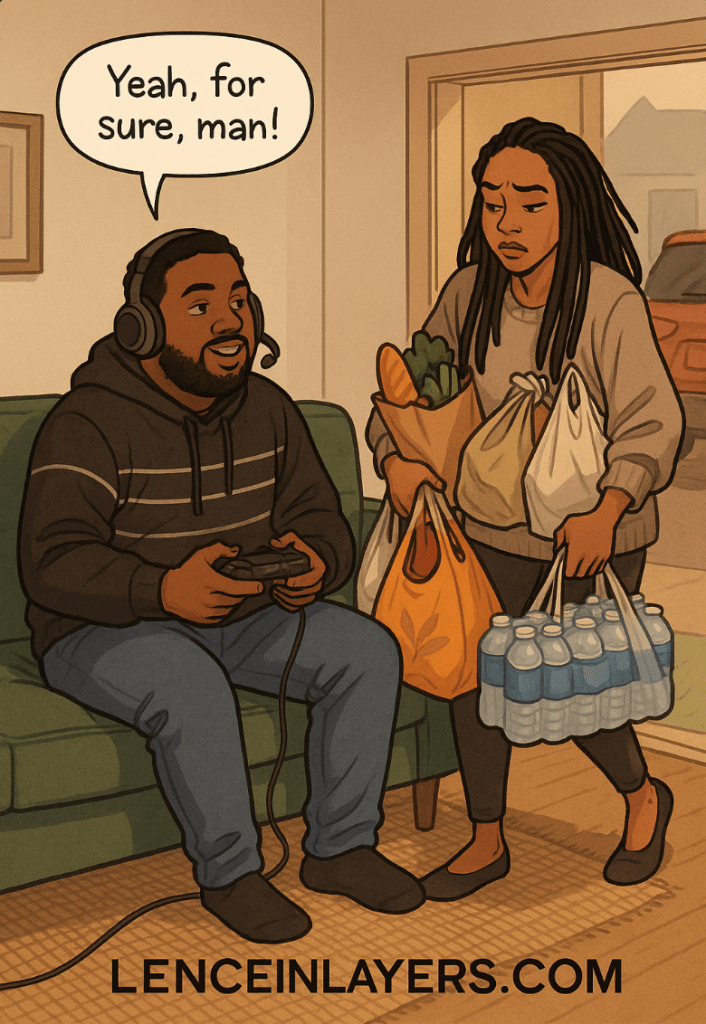
The message is clear: if only she had done more, he would have grown. All this tells you is that the bar is in hell. Besides, growth doesn’t work that way. It is an individual choice. A man either decides to take responsibility for himself, or he doesn’t. You can’t love, cook, bribe, or nag someone into maturity or respecting the relationship.
His dependence isn’t proof of her failure. It’s evidence of familial enabling and his refusal to take ownership of how his inertia (and lack thereof) impacts the people around him. Yet, time and again, women are positioned as the scapegoat, shouldering blame for cracks in the relationship that were never theirs to repair.
The Hard Truth About Growth
Please understand that a man will only grow if he chooses to do so. Sometimes, meeting the right partner acts as a wake-up call. But, let’s be clear: she isn’t raising him. She simply represents a relationship he doesn’t want to lose, and sometimes that can jolt him into action.
And here’s the stinging truth women need to grasp early: that won’t always be you. Sometimes he just doesn’t care enough about the partner he’s currently with to change. He may step up later, but only if he wants to. That doesn’t mean you weren’t “enough.” It means he wasn’t willing. Waiting around in the hope that he’ll transform usually leads to wasted years. If he isn’t choosing growth now, then that is your answer.
Breaking the Cycle
- For men: Real growth begins with accountability. Therapy or just saying “I’ll handle it” and following through can be radical.
- For women: Watch for red flags. If you find yourself feeling more like his mother than his partner, believe that signal.
- For families: Raise boys with equal expectations. Dishes, emotions, chores, and responsibility should be part of their upbringing just as much as their sisters’.
Until we stop excusing immaturity as “just how men are,” the cycle will continue.
Final Thoughts
No woman enters a relationship dreaming of becoming Mom 2.0 to a grown man. And no man gains strength by sidestepping adulthood. The bottom line? He will only change if he chooses to and if he isn’t showing you that effort now, clinging to his “potential” won’t make it real. Potential is just a ghost; it can’t split the bills, book the pediatrician appointment, or stand by you when life gets messy.
You deserve a partner whose “castle” is already standing—someone who has built a life he can sustain, where you’re not laying the bricks for him, but adding the finishing touches that make it richer, warmer, and stronger. A man who can defend what he’s built alongside you, not hand you the blueprints and expect you to construct it.
The most powerful move you can make is to refuse to settle for half-formed promises. You’re not meant to raise him, repair him, or build him. You’re meant to step into a partnership where your presence elevates what’s already there.
 Lence in Layers