
Voting in the United States is not just about showing up anymore.
It is about whether:
(1) you can register easily;
(2) your identification is accepted; and
(3) the rules change before you even get the chance to find out.
The SAVE Act is not a distant idea. It has already passed the House, and is now being pushed forward in Congress.
If it becomes law, it could change how people register to vote ahead of the next election aka Midterms.
But, let’s not get ahead of ourselves. Let’s dive into what is most important to know right now.
What the SAVE Act Does
The Safeguard American Voter Eligibility Act, known as the “SAVE Act,” is proposed federal legislation that would require documentary proof of citizenship, such as a passport or birth certificate, when registering or updating voter registration.
Ever notice how the most insidious policies often come with the nicest names? That is by design. It is easier to win support when something sounds positive, especially in a country where many adults struggle with literacy and are less likely to read beyond the title, but I digress…
The SAVE Act has not been enacted into law.
Currently, most states allow people to register by affirming their citizenship under penalty of law, with verification systems already in place. The SAVE Act would shift that responsibility, requiring individuals to provide documentation upfront.
That may sound straightforward, but access to documents is not evenly distributed. Estimates suggest millions of Americans do not have immediate access to documents like passports or birth certificates.
So, the issue is not whether only citizens should vote. That is already the law.
The real issue is how easy it is for eligible citizens to participate.
What People Are Being Told
There are persistent claims driving urgency around voting restrictions:
- That elections are widely stolen
- That undocumented immigrants are voting
- That undocumented immigrants are heavily using public benefits
These claims are repeated often. But, fear-mongering and repetition are not the same as evidence.
What the Data Actually Shows
Investigations, audits, and court cases have consistently found no evidence of widespread voter fraud. Non-citizens voting in federal elections is already illegal and extremely rare.
Undocumented immigrants also do not fit the narrative often used in policy debates. They contribute tens of billions of dollars in taxes each year, including sales, property, and payroll taxes, while being largely ineligible for most federal benefits.
At the same time, research consistently shows they are less likely to commit crimes than U.S.-born individuals. Studies suggest this is partly due to higher risks associated with system contact, including deportation, and strong incentives to remain economically active and avoid legal trouble.
How Data Gets Framed
It is also worth paying attention to how data is sometimes presented in public discourse.
Research that claims the opposite often relies on narrower samples or selective framing of subgroups rather than population level trends. Broader, longitudinal studies that look across regions and time consistently point in the same direction.
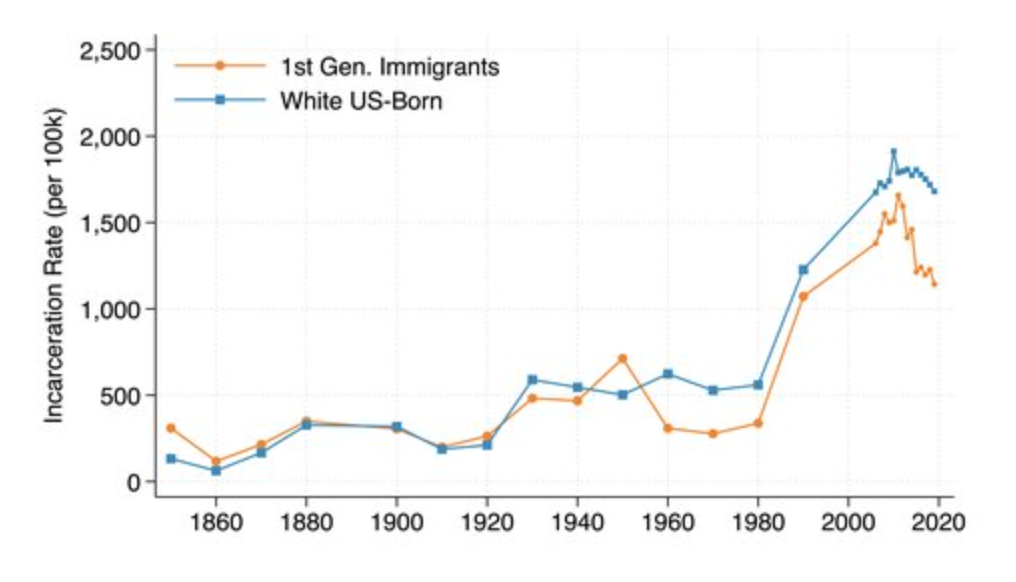
Just as important is what is not always centered. Crime data in the United States shows that offenses are not concentrated in the way many public narratives suggest. Over 150 years of U.S. data shows immigrants are not more likely to commit crimes and are often significantly less likely to be incarcerated than U.S.-born men, including white men.
It is also important to clarify what this research captures. Much of the long-term data compares U.S.-born individuals to the broader foreign-born population, and does not always distinguish between documented and undocumented immigrants.
However, more recent studies that do make this distinction consistently find that both groups, including undocumented immigrants, have lower crime rates than U.S.-born individuals. In fact, undocumented immigrants were found to be less than half as likely to be arrested for violent crimes compared to U.S.-born citizens. Yet, conversations frequently focus on marginalized groups while avoiding broader context.
One additional example is the reliance on arrest rates instead of conviction rates. Arrests reflect who is policed, not necessarily who is guilty. If certain communities, particularly Black communities, are more heavily surveilled or targeted, arrest rates will reflect that attention. However, if those cases do not hold up in court, that tells a different story about bias.
Conflating arrests with guilt distorts reality. It turns patterns of enforcement into assumptions about behavior.
That imbalance shapes perception, and perception shapes policy.
As someone who works in data, I have seen how framing decisions can shift attention away from what the data actually shows. This approach does not change the underlying numbers. It only changes the narratives people are encouraged to notice.
After all, policies built on incomplete (or selectively framed) data rarely produce the intended outcomes.
Why Midterm Elections Matter
Midterm elections determine who controls Congress. That control decides which policies move forward, which stall, and which never see the light of day. They influence funding for healthcare, education, and infrastructure.
They also shape future election rules.
In short, midterms are not ‘whatever.’ They are structural to how power actually functions in this country.
save Key 2026 Dates
- August 4, 2026 — Michigan primary election (1, 2)
- November 3, 2026 — General election (federal midterms)
These dates matter because they determine who will shape what happens next.
Policies like the SAVE Act can be passed before the midterms. However, elections decide how those policies are implemented, enforced, challenged, or expanded.
If You Live in Michigan
Do not assume you are registered. Please periodically check.
Go to:
- Michigan Voter Information Center at Michigan.gov/Vote
There, you can:
- Confirm your registration
- Update your address
- Find your polling location
- Track your absentee ballot
Registration basics in Michigan
More information can be found here, but in general:
- You can register online or by mail up to 15 days before the election
- Within 14 days of the election, registration must be done in person at your local clerk’s office
- You can register on Election Day in person with proof of residency
Michigan also allows ‘no excuse absentee voting’, meaning you can vote by mail without providing a reason.
That flexibility is helpful, but if you can vote in person, I highly recommend it.
If You Live Anywhere Else in the U.S.
Use:
- Vote.gov
From there, you can:
- Check your registration
- Register or update your information
- Find your state specific deadlines
Every state has its own rules and timelines, which is why using a central site matters.
What To Do Right Now
Take five minutes and remove the uncertainty.
If you are in Michigan:
- Go to Michigan.gov/Vote
- Confirm your registration and address
If you are in another state:
- Go to Vote.gov
- Do the same
Voting is not just about showing up on Election Day.
It is about making sure you can.
Final Thought
Policies can change quickly. Narratives can spread even faster—like measles cases in the U.S. and Michigan right now. The gap between what people believe and what the data actually shows can shape entire elections. So, before you absorb another headline or repeat another claim, please pause. Look at the data and look at it more than once. Ask who is being centered and who is being left out and why that may be the case. Always ask yourself, who does this serve and what agenda? And then act with informed intention.
Because at the end of the day, the most powerful thing you can do is not only have an opinion.
It is to make sure the ease with which your voice is heard remains in tact.
References
Abramitzky, R., Boustan, L. P., Jácome, E., Pérez, S., & Torres, J. D. (2024). Law-abiding immigrants: The incarceration gap between immigrants and the U.S.-born, 1870–2020. American Economic Review: Insights, 6(4), 453–471. https://doi.org/10.1257/aeri.20230459
Brennan Center for Justice. (2023). The truth about voter fraud. https://www.brennancenter.org
Campaign Legal Center. (2026). What you need to know about the SAVE Act. https://campaignlegal.org/update/what-you-need-know-about-save-act
Institute on Taxation and Economic Policy. (2023). Undocumented immigrants’ state and local tax contributions. https://itep.org
Light, M. T., He, J., & Robey, J. P. (2020). Comparing crime rates between undocumented immigrants, legal immigrants, and native-born U.S. citizens in Texas. Proceedings of the National Academy of Sciences, 117(51), 32340–32347. https://doi.org/10.1073/pnas.2014704117
Migration Policy Institute. (2023). Immigrants and crime in the United States. https://www.migrationpolicy.org
Michigan Department of State. (2026). Register to vote. https://www.michigan.gov/sos/elections/voting/register-to-vote
Michigan Department of State. (2026). Elections and voting. https://www.michigan.gov/sos/elections
Pew Research Center. (2020). Facts on undocumented immigrants. https://www.pewresearch.org
U.S. General Services Administration. (2025). Register to vote. https://vote.gov/register
U.S. General Services Administration. (2025). Confirm your voter registration. https://www.usa.gov/confirm-voter-registration
 Lence in Layers