
There is a certain kind of inconvenience that is easy to dismiss.
The deodorant is locked up.
You press a button and wait.
No one comes.
You wait longer.
It is mildly irritating. Nothing more.
The produce section looks sparse. The apples are bruised. The lettuce wilts early. The shelves lean heavily toward packaged foods with long ingredient lists. Red #40. Preservatives. Added sugar in everything.
You make do.
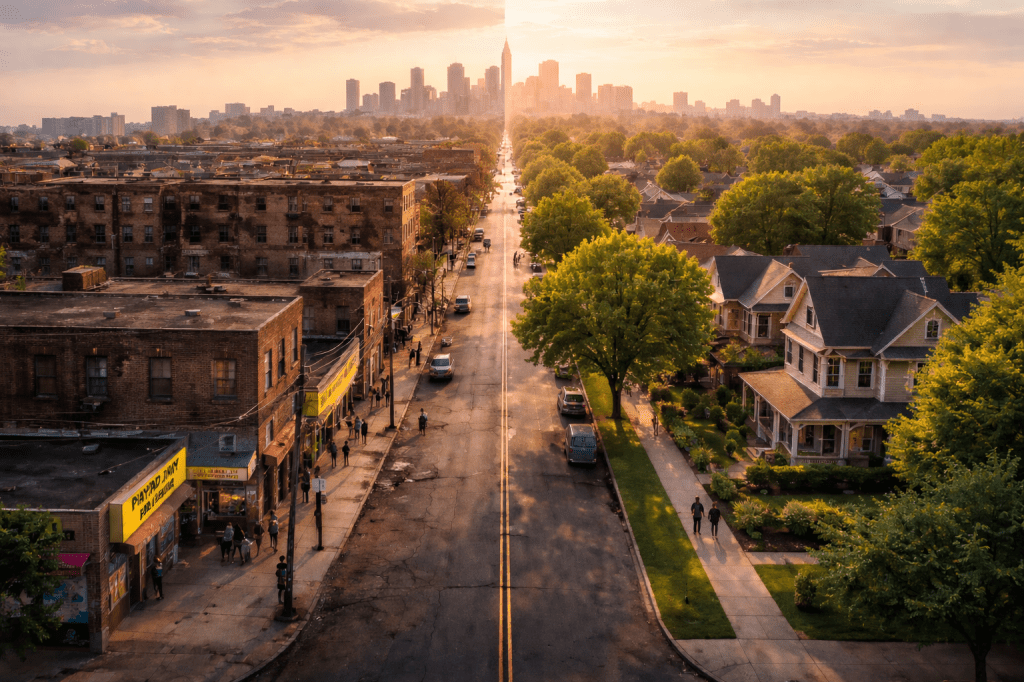
The air feels hotter in summer. The sidewalks are narrower.
There are fewer trees. There is nowhere to sit outside that feels maintained.
You adjust.
Across town, there is another store.
The shelves are open. The lighting is warmer. The produce is abundant. The beauty products are sealed and not covered in theft detection stickers you have to steam off. The same brand exists in both places, but here, the inventory looks newer.
There are more banks than payday lenders. More parks than liquor stores. More shade than concrete.
Very few regularly experience both.
I do.
Because of the sacrifices my parents were able to make and the access to strong schools that followed, I have been able to move between these two realities. I quietly worked my way into rooms and neighborhoods that were not always designed with me in mind. I can drive thirty five minutes each weekend to shop in the version of the city where the shelves are open and the produce is abundant.
But, here’s the thing: I shouldn’t have to. Nor should anyone.
Small Frictions
None of these differences, on their own, feel dramatic.
A five dollar limit on rewards use per visit.
A locked case.
A longer walk to find fresh food.
A service interaction that feels subtly cooler.
Each moment is minor. Easy to rationalize.
Stores respond to theft patterns.
Corporations optimize profit.
Inventory varies by location.
Trees grow where they were planted.
Individually, each explanation seems reasonable.
Layered together, something else begins to form.
Food Access Is Structured
The United States Department of Agriculture’s Food Access Research Atlas documents significant disparities in proximity to supermarkets across income and racial lines (United States Department of Agriculture, 2023). Peer reviewed research consistently finds that predominantly Black neighborhoods have reduced access to full service grocery stores compared to predominantly White neighborhoods, even after controlling for income (Walker, Keane, & Burke, 2010).
These disparities are not incidental. They reflect long standing patterns of commercial disinvestment shaped by housing segregation and lending practices (Rothstein, 2017).
Access to fresh food is not simply about diet. It is about infrastructure.
Environmental Inequality Is Measurable
Urban tree canopy coverage is not created equal, nor evenly distributed.
A national study examining 37 United States cities found that neighborhoods shaped by residential segregation have significantly lower tree canopy coverage than wealthier and predominantly White neighborhoods (Locke et al., 2021). Lower canopy coverage correlates with increased surface temperatures and heat exposure.
Research published in the American Journal of Public Health demonstrates that neighborhoods historically graded as high risk under redlining policies remain hotter today due to reduced green infrastructure investment (Hoffman, Shandas, & Pendleton, 2020).
Heat exposure is associated with cardiovascular strain, respiratory illness, and increased mortality risk.
Shade, it turns out, is not harmless, nor random.
Financial Infrastructure and Concentrated Risk
The concentration of financial services also follows historical patterns.
Research on alternative financial services shows that payday lenders and check cashing outlets cluster in lower income and predominantly minority neighborhoods (Prager, 2016). These high cost financial products often carry annual percentage rates exceeding three hundred percent.
Meanwhile, traditional banking institutions are less densely distributed in these same areas, limiting access to wealth building tools such as low interest credit and mortgage financing (Baradaran, 2017).
The result is not merely inconvenience. It is structural economic ignorance and vulnerability.
Surveillance and Retail Profiling
Retail surveillance practices also disproportionately affect communities of color.
Research in consumer discrimination has documented that Black shoppers report higher rates of surveillance, suspicion, and unequal treatment in retail environments (Williams & Mohammed, 2009). Experimental studies in economic behavior demonstrate that implicit racial bias influences expectations of dishonesty and financial reliability (Bertrand & Mullainathan, 2004).
When essential items are locked in certain neighborhoods, but not others, it reflects a broader pattern of risk modeling that maps onto racialized assumptions.
No policy needs to be explicitly discriminatory for its impact to be felt .
The Geography of Inequality
These patterns trace back to housing policy.
Redlining maps created by the Home Owners Loan Corporation in the nineteen thirties labeled Black neighborhoods as hazardous for investment. Though redlining was formally outlawed, the spatial logic of those maps continues to shape infrastructure, environmental quality, and commercial investment (Rothstein, 2017).
Contemporary research confirms that formerly redlined neighborhoods experience higher heat exposure, lower tree canopy coverage, fewer supermarkets, and greater concentration of alternative financial services (Hoffman et al., 2020; Locke et al., 2021).
History did not disappear. It simplely reorganized and rebranded.
Two Realities at Once
If you live in a neighborhood with open shelves, shaded streets, accessible grocery stores, and nearby banks, your experience likely feels standard.
If you live in a neighborhood where essentials are locked, fresh food is scarce, trees are sparse, and payday lenders are abundant, that experience also feels standard.
Two realities can coexist.
Sociologist Eduardo Bonilla Silva describes this phenomenon as racism without racists. Systems uphold inequality through policy, infrastructure, and economic design even when individuals deny overt prejudice (Bonilla Silva, 2018).
Systemic racism often operates not through explicit exclusion, but through uneven distribution. It shapes where investment flows, where surveillance concentrates, and where environmental protection is prioritized.
The result is not always dramatic. It is cumulative.
It shows up in grocery aisles.
In temperature maps.
In loan agreements.
In locked cabinets.
The differences may appear small in isolation. Together, they form a structure.
To simply reduce these disparities to laziness is to ignore history. Wealth in the United States did not emerge in a vacuum. It was built through land seizures, enslaved labor, exclusionary housing policy, discriminatory lending, and unequal access to education and capital. The benefits of those policies compounded across generations. As did the barriers.
Hard work does not erase redlining maps. It does not plant trees where investment was withheld. It does not undo decades of capital flowing in one direction.
When two neighborhoods begin from different starting lines and operate under different conditions, effort alone cannot explain the outcome.
Understanding inequality requires noticing patterns, not just individual behavior. Two realities can exist at once. The question is whether we are willing to acknowledge how they were built and to rebuild better.
References
Baradaran, M. (2017). The color of money: Black banks and the racial wealth gap. Harvard University Press.
Bertrand, M., & Mullainathan, S. (2004). Are Emily and Greg more employable than Lakisha and Jamal? A field experiment on labor market discrimination. American Economic Review, 94(4), 991–1013.
Bonilla Silva, E. (2018). Racism without racists: Color blind racism and the persistence of racial inequality in America (5th ed.). Rowman & Littlefield.
Hoffman, J. S., Shandas, V., & Pendleton, N. (2020). The effects of historical housing policies on resident exposure to intra urban heat. American Journal of Public Health, 110(6), 106–112.
Locke, D. H., et al. (2021). Residential housing segregation and urban tree canopy in 37 US cities. npj Urban Sustainability, 1(15).
Prager, R. A. (2016). Determinants of the locations of payday lenders. Federal Reserve Board Finance and Economics Discussion Series.
Rothstein, R. (2017). The color of law: A forgotten history of how our government segregated America. Liveright Publishing.
United States Department of Agriculture. (2023). Food Access Research Atlas.
Walker, R. E., Keane, C. R., & Burke, J. G. (2010). Disparities and access to healthy food in the United States: A review of food deserts literature. Health & Place, 16(5), 876–884.
Williams, D. R., & Mohammed, S. A. (2009). Discrimination and racial disparities in health. Journal of Behavioral Medicine, 32(1), 20–47.
 Lence in Layers