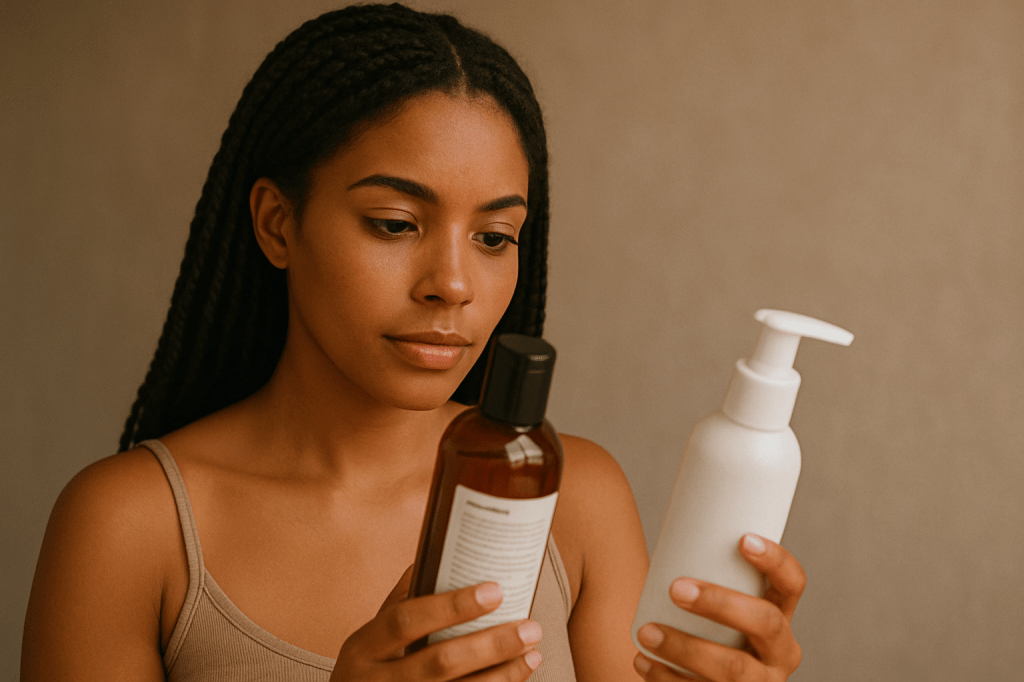
I’m a Black woman who deeply values wellness. I care about what I eat, how I move, and yes, what I put on my skin and in my hair.
But, there’s one thing I’ve stopped doing:
I no longer blindly buy products that are marketed specifically to women who look like me.
It’s not about rejecting my identity. It’s about protecting it. Many beauty and personal care products marketed to Black women and other women of color have a long, disturbing history of being more toxic, not less.
Reproductive Eugenics Disguised as Beauty
This isn’t paranoia. It’s pattern recognition. And if you knew what I do for work, you’d know it’s like a superpower. Useful, but heavy.
For decades, Black women’s bodies have been the target of experimentation, exploitation, and silent harm. From forced sterilizations during the eugenics movement in the early 1900s in the U.S., peaking between the 1920s and 1940s to modern-day medical racism, there’s a dark undercurrent of control and neglect that runs through the systems meant to care for us.
Beauty isn’t separate from this history, it’s part of it. And when you follow the money, the science, and the marketing, the pattern is clear and hard to ignore.
The Silent Health Crisis in Our Products
Did you know that over 80% of products marketed to Black women contain endocrine-disrupting chemicals linked to hormone imbalance, fibroids, early puberty, infertility, and even cancer?
We’re talking about:
- Hair relaxers and perms
- Bleaching creams
- Synthetic fragrances
- Petroleum-based moisturizers
- Talc-containing powders
Black women in the U.S. are 2–3 times more likely to develop fibroids than white women. They are more likely to suffer severe symptoms, undergo hysterectomies, and face complications tied to hormonal imbalances.
This isn’t coincidence. It’s a dangerous pattern hiding behind the mask of self-care.
Marketing That Plays on Insecurity
Many of the products targeting Black and brown women prey on internalized bias, promising straighter hair, lighter skin, smaller pores, and a “cleaner” look that conforms to Eurocentric standards.
And because we grow up seeing these products in our aunties’ cabinets, in our salons, and on the shelves labeled “ethnic care,” we learn to trust them. We learn to rely on them.
However, very few of these brands are actually created by us, or for our well-being. They’re created by conglomerates eager to profit—not only from our pain, but from slowly warping our confidence and narrowing our sense of what beauty looks like.
Just look at the recent American Eagle ad featuring Sydney Sweeney and the tagline “jeans built on great genes,” a not-so-subtle wink toward Eurocentric ideals of beauty that tie physical features like blonde hair and blue eyes to genetic superiority. These messages aren’t accidental. They’re strategic and in the past, they shaped the way we see ourselves and each other. And no, I’m not linking the video. The messaging was loud enough.
What I Buy Instead
I’ve learned to flip the label. I look for transparency, not targeted packaging. I want:
- Fragrance-free or naturally scented
- Non-toxic, EWG-rated ingredients
- Products made by Black-owned wellness brands that prioritize safety, not just sales and remain independent from large conglomerates
I’ve traded miracle growth oils for scalp-loving jojoba. I’ve swapped my old creamy cleansers for ones that won’t mess with my pH. And when in doubt, I go minimal, but best believe, I always smell good, steeped in oils for the gods. My favorites? Vanilla, almond, and lavender oil (at night).
Because the real glow-up? It’s not found in a bottle.
It’s in the peace of knowing your beauty routine doesn’t cost you your health.
Final Thoughts
Being a conscious Black woman in the beauty aisle is annoying and exhausting. But, it’s also empowering.
There’s a quiet kind of relief you feel after a clean check-up, knowing those little choices added up to something good and that all those mindful swaps weren’t just about ingredients. They were about freedom, safety, and care.
So no, I don’t trust every brand that claims to “celebrate my beauty.”
Loving myself means demanding better and that starts with what I allow on, and in, my body.
Looking for safer alternatives?
The Campaign for Safe Cosmetics has a curated list of safer Black-owned and Black-serving beauty brands (2024). It’s a great place to start if you’re ready to shop more consciously without compromising your health.
References
Blackshear, C. T., et al. (2021). The role of endocrine-disrupting chemicals in Black women’s reproductive health: A review of the literature. Environmental Health Perspectives, 129(3), 036001.
Breast Cancer Prevention Partners. (2020). Not so pretty: Toxic products marketed to Black women. Campaign for Safe Cosmetics. https://www.bcpp.org/resource/not-so-pretty/
Campaign for Safe Cosmetics. (2020). Not so pretty: Toxic products marketed to Black women. Breast Cancer Prevention Partners. https://www.safecosmetics.org
Helm, R. (2019). Beauty and the beast: The toxic burden of everyday cosmetics. Environmental Working Group (EWG). https://www.ewg.org
James-Todd, T., Terry, M. B., Rich-Edwards, J., Deierlein, A., & Senie, R. (2013). Lifetime exposure to hair relaxants and risk of uterine leiomyomata in African-American women. American Journal of Epidemiology, 178(3), 402–410.
Zota, A. R., & Shamasunder, B. (2017). The environmental injustice of beauty: Framing chemical exposures from beauty products as a health disparities concern. American Journal of Obstetrics and Gynecology, 217(4), 418.e1–418.e6.t Cancer Prevention Partners. (2020). Not so pretty: Toxic products marketed to Black women. Campaign for Safe Cosmetics. https://www.bcpp.org/resource/not-so-pretty/
 Lence in Layers